
In Part 3.4, we discussed what I consider the secret weapon of weight loss: walking.
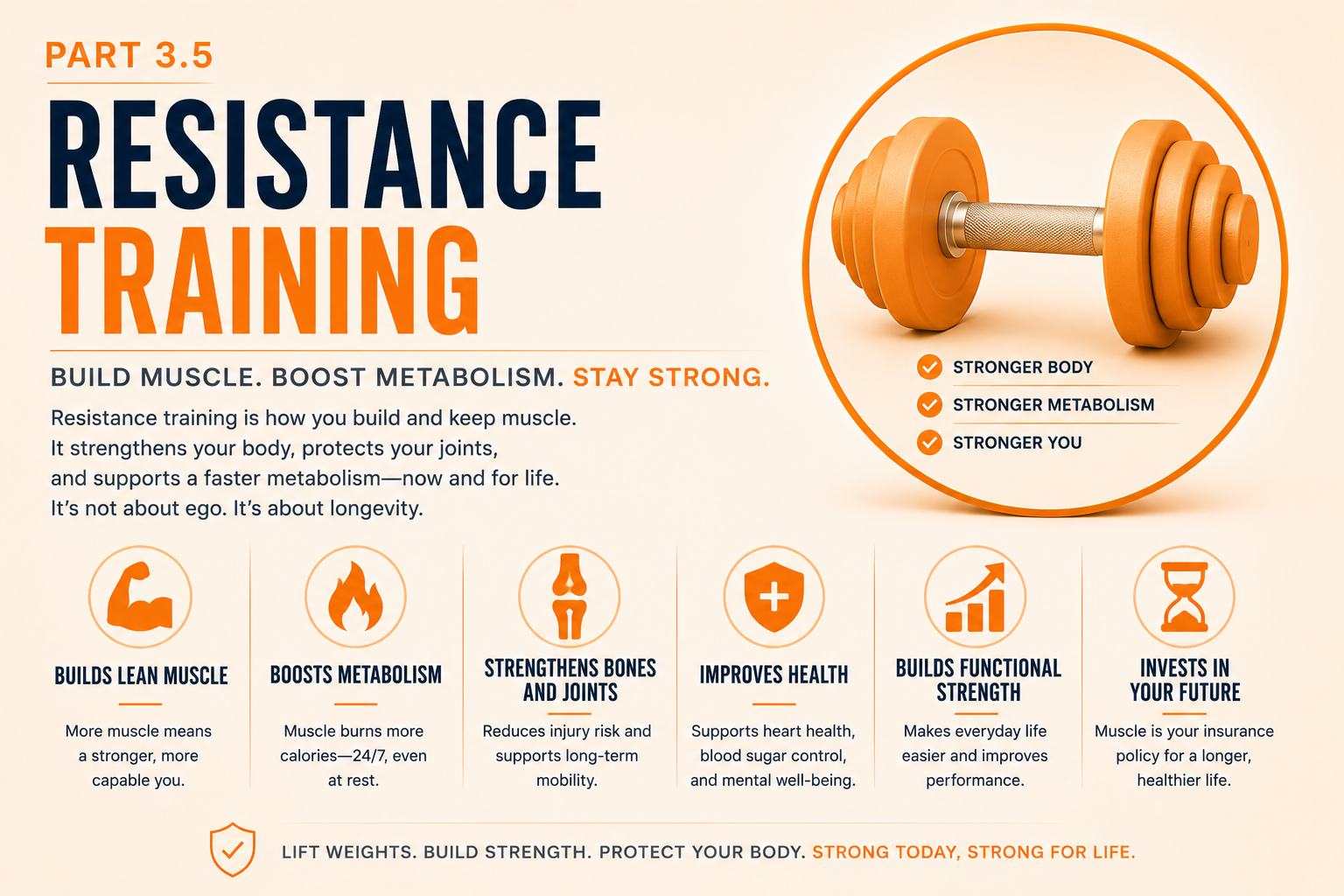
In Part 3.5, we will discuss another critical—but often neglected—component of successful weight loss: resistance training.
Why Resistance Training Matters
If you think about it, body weight itself is really just a number on a scale. What matters far more is where that weight comes from.
For example, imagine two people of the same height, but one weighs 10 pounds more than the other. Which person is healthier and likely to live longer?
You cannot answer that question based on body weight alone.
What matters more is body composition:
- how much of that weight is fat,
- how much is muscle,
- and how well the body functions overall.
In most cases, a person with:
- more lean muscle mass,
- lower body fat percentage,
- and better physical function
will be healthier than someone who is lighter but has less muscle and more body fat.
The Importance of Muscle Mass
Having more lean muscle mass improves overall function and quality of life in many ways.
It:
- increases strength and power output,
- improves mobility and athletic performance,
- protects against injury,
- reduces fall risk,
- improves recovery after falls,
- and allows us to maintain independence as we age.
Muscle is one of the greatest predictors of healthy aging.
In general, humans lose approximately 10% of muscle mass per decade over time.
This does not mean we cannot continue getting stronger as we age.
In fact, many people who begin resistance training later in life can continue building muscle and strength for years—sometimes decades—because they are still far from their genetic potential.
What I mean is this:
If someone were already at their absolute genetic peak, then some degree of age-related muscle decline would eventually become inevitable despite continued training.
However, for most people starting resistance training later in life, there is enormous room for improvement.
Resistance Training During Weight Loss
This becomes especially important during weight loss.
When we maintain a calorie deficit, the body does not exclusively lose fat. Without resistance training, we will often lose:
- fat,
- muscle,
- and strength simultaneously.
We do not want this.
Resistance training sends a signal to the body that muscle tissue is important and should be preserved.
In simple terms, weight training tells the body:
“Keep the muscle. Use the fat instead.”
This is one of the keys to successful body recomposition.
A Disclaimer
Resistance training is a massive topic and honestly deserves an entire blog series of its own.
In this post, I will simply outline what I personally did during the first year of my health transformation to hopefully provide some ideas for how you might begin.
As always, a disclaimer:
I strongly recommend learning resistance training from:
- a qualified personal trainer,
- an experienced friend,
- or another knowledgeable mentor.
Trying to learn lifting mechanics exclusively from the internet carries a higher risk of injury because you do not receive real-time feedback on technique and form correction.
Personally, I believe that learning proper resistance training technique is one of the best investments of time and money a person can make. The return on that investment compounds for the rest of your life in:
- health,
- physical function,
- confidence,
- longevity,
- productivity,
- and quality of life.
My “One Lift a Day” System
One of my personal “hacks” for resistance training is what I call:
One Lift a Day
This concept was heavily inspired by Atomic Habits and the philosophy of consistency over perfection.
The idea is simple:
Every day, I commit to stepping into the gym and completing one lift only.
One lift means:
- 3–4 working sets
- of a single exercise.
That is the minimum requirement.
If I feel good afterward, I may continue and do more exercises.
If I feel tired, stressed, sick, or unmotivated, I still complete the one lift and leave.
This system dramatically lowers the mental barrier to training.
Doing one exercise per day may only take:
- 15–20 minutes,
yet it probably produces: - well over 50% of the benefits
for a fraction of the time investment.
Most importantly, it reinforces the identity and habit of showing up consistently.
Variations of many of these exercises can also be performed at home with minimal equipment, which further reduces barriers to entry.
Consistency Over Perfection
Will one exercise per day build as much muscle as a full 90-minute bodybuilding workout?
Probably not.
But the goal is sustainability.
A moderate program performed consistently for years will outperform an “optimal” program that is constantly abandoned.
You are far less likely to skip a session when the minimum expectation feels manageable.
Over time, that consistency compounds into remarkable progress.
Again:
Consistently good is better than occasionally great.
The Six Foundational Movement Patterns
These are the six fundamental movement patterns I would focus on mastering first:

Lower Body Push
Example:
- Squat
Lower Body Pull / Hinge *
Example:
- Deadlift
- * High Injury Risk if not done properly
Upper Body Horizontal Push
Example:
- Bench Press
Upper Body Horizontal Pull
Example:
- Row
Upper Body Vertical Push
Example:
- Shoulder Press
Upper Body Vertical Pull
Example:
- Pull-Up
And as a bonus—and a shoutout to my good friend Terry Jiang, who is also a personal trainer—especially for those who want to improve athletic performance in sports, I would also strongly recommend incorporating two additional foundational movement patterns:
- Lunge
- Twist / Rotational Movements
These movements are incredibly important for:
- balance,
- coordination,
- core stability,
- rotational strength,
- injury prevention,
- and real-world athletic function.
Many sports and daily activities involve moving through multiple planes of motion, not just straight up and down. Learning to stabilize, rotate, and generate force dynamically is an important part of becoming a more functional and resilient athlete.
In general, with repetitions, I would suggest choosing a weight that you can perform for approximately 8 reps with good form. From there, progressively increase by about 1 rep every week or two until you can comfortably perform 12 reps with good technique. Once you can complete 12 solid reps, slightly increase the weight and work your way back down to 8 reps again, gradually progressing back toward 12. Then repeat the cycle.
This is a simple and effective form of progressive overload that allows the body to adapt gradually while minimizing injury risk. Most importantly, prioritize proper form and control over the amount of weight being lifted.
Once these movement patterns are learned, most other exercises become significantly easier to understand and incorporate.
I will not attempt to teach these lifts in detail through this blog because I firmly believe resistance training technique is safest and most effective when taught in person.
My Minimalist Weekly Structure
During the first year of my transformation, my minimum training schedule looked like the following. As a matter of personal preference—and as a slightly more experienced lifter by that point—I preferred lifting somewhat heavier weights with lower repetitions:
Sunday
Barbell Back Squat
4 sets of 6 reps
Monday
Barbell Bench Press
4 sets of 6 reps
Tuesday
Dumbbell Bent-Over Row
4 sets of 10 reps per arm
Wednesday
Barbell Deadlift
4 sets of 6 reps
Thursday
Barbell Shoulder Press
4 sets of 6 reps
Friday
Weighted Pull-Ups
4 sets of 6 reps
Saturday
Rest Day
I typically trained first thing in the morning.
Again, this was my minimum commitment. Most days I performed additional exercises, but I always maintained the “one lift minimum” rule.
Progressive Overload
One of the most important concepts in resistance training is:
Progressive Overload
This means gradually increasing the challenge placed on the body over time.
As the body adapts and becomes stronger, we slowly increase:
- weight,
- repetitions,
- training volume,
- or training difficulty.
For me personally, I only increased weight once I could comfortably perform:
- 1–2 additional reps
on the final set of an exercise.
For example:
If my target deadlift was 4 sets of 6 reps, but I could comfortably perform 8 reps on the final set, then I would slightly increase the weight the following week.
Progression should be gradual and patient.
Let Fitness Come to You
Expectation setting is extremely important.
Do not expect to become stronger every single week.
Let fitness come to you. Do not chase it impatiently.
One of the biggest mistakes people make is adding weight too quickly to satisfy the ego, only to end up injured.
Progression should only occur when movements feel solid and comfortable throughout the entire body.
For example:
Even if your legs feel strong during a squat, if you feel instability or discomfort elsewhere—such as your back, hips, knees, or smaller stabilizing muscles—do not rush progression.
You are only as strong as the weakest link in the chain.
Patience is critical.
Progress often feels frustratingly slow in the short term, but if you remain consistent over 1–2 years, the cumulative changes can become extraordinary.
Comparison Is the Enemy
Finally:
Do not focus on what other people are lifting.
Everyone has:
- different genetics,
- different training histories,
- different injury histories,
- and different starting points.
Be proud that you are showing up and investing in yourself.
The only meaningful comparison is against your past self.
In Part 3.6, we will discuss another enormous topic: diet and nutrition.

Leave a Reply