
In Part 3.0, I laid the foundation by introducing the basic science of weight management, nutrition, calorie balance, and an overview of what is to come in the subsequent parts of this mini-series.
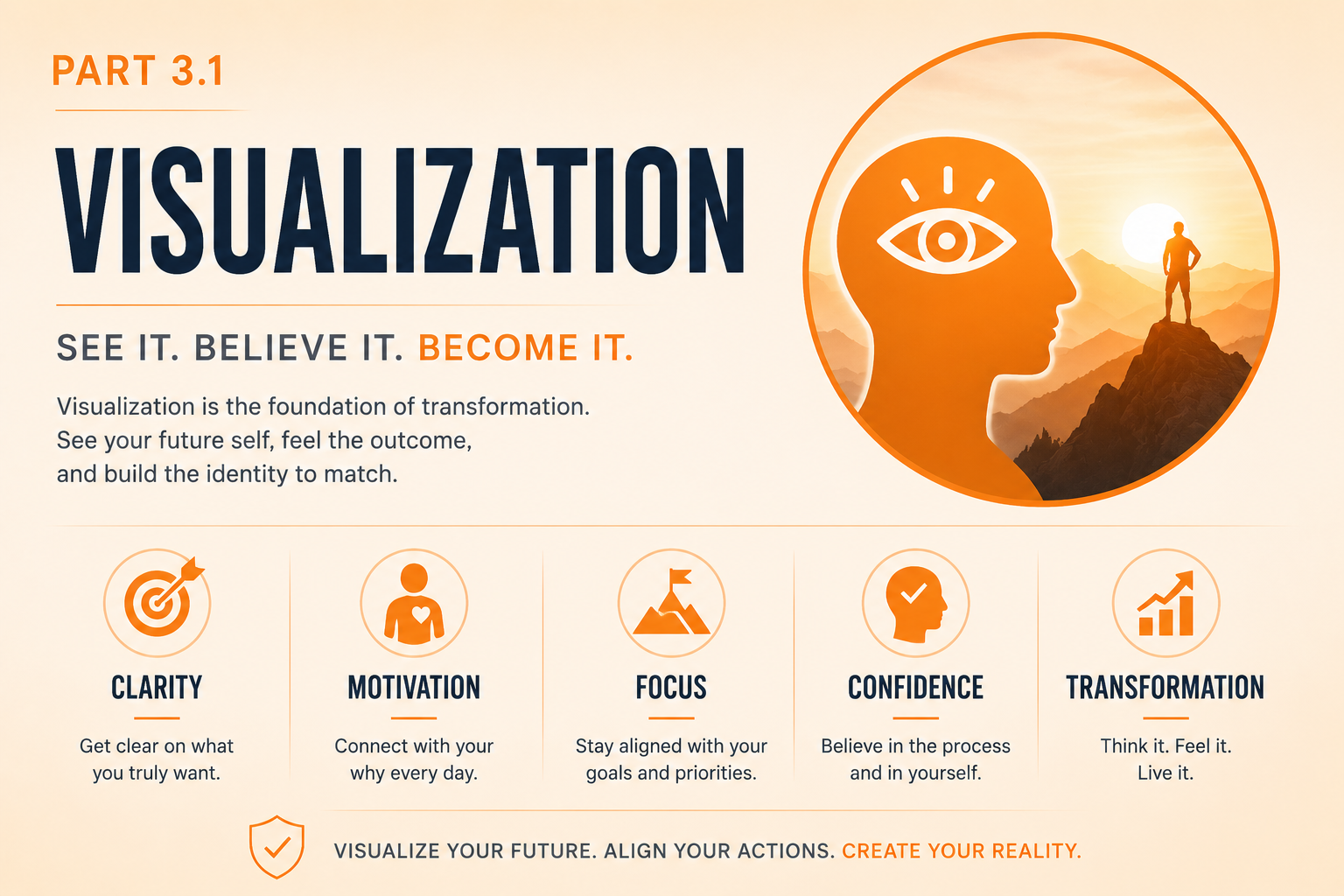
In Part 3.1, we will discuss the power of visualization and change, because any meaningful change we make in our lives—whether related to weight loss, fitness, career, relationships, or personal growth—must first begin in the mind.
We have all experienced this before. A new year begins, and we set ambitious New Year’s resolutions. For the first few days, weeks, or even months, we feel motivated and energized. But over time, that motivation fades, and eventually many people fall short of the goals they originally set for themselves.
The root problem is this: motivation can help us start a new behavior, but it is usually not enough to sustain it long-term.
Relying on motivation alone will only take us so far.
This is why it is critically important to ask yourself why you want to make a change in the first place. You need a “north star”—something meaningful that you can return to when motivation fades and you feel lost or discouraged.
Ultimately, long-term success is built on consistency and persistence, not fleeting motivation.
Having a strong “why” allows us to continue our habits even when we no longer feel motivated. The human mind is incredibly powerful. If we genuinely believe that we can achieve something, we are far more likely to improve than if we never believed in ourselves at all—even if we fall short of perfection.
The Six Levels of Change
There are six levels of change:
- Environment
- Behaviour
- Capability and Skills
- Beliefs and Values
- Identity
- Purpose / Spirituality
For example, many New Year’s resolutions to lose weight only affect the first two levels. Some people may progress to Level 3 before eventually giving up. Level 4 is often necessary for long-term success, but even that alone may not be enough.
To truly sustain change over the long term, I believe a person must eventually reach at least Level 5: Identity.
Level 6—the level of Purpose or Spirituality—is perhaps the highest form of transformation, where your actions become connected to something larger than yourself.
Let’s go through each level in more detail.
1. Environment
Environment refers to the external conditions surrounding you.
This includes:
- the foods available in your home,
- the people around you,
- your schedule,
- your workplace,
- your routines,
- and even the physical spaces you spend time in.
Many people begin their weight loss journey by changing their environment:
- buying healthier groceries,
- joining a gym,
- purchasing workout clothes and running shoes,
- meal prepping,
- or removing junk food from the house.
These are important first steps because our environment strongly influences our behaviour. However, changing your environment alone is usually not enough.
For example:
“I signed up for a gym membership and bought running shoes.”
That is an environmental change—but it does not guarantee lasting action.
2. Behaviour
Behavior refers to the actions you actually perform.
Examples include:
- walking daily,
- tracking calories,
- resistance training,
- meal prepping,
- or reducing late-night snacking.
This is where most people begin to rely heavily on motivation.
At this level, someone may say:
“I’m going to exercise every day and stop eating junk food.”
And initially, they may succeed.
But when stress, fatigue, work, illness, or life circumstances arise, behaviours often collapse if they are not supported by deeper levels of change.
Behavioural change without deeper internal transformation is often temporary.
3. Capability and Skills
This level involves learning how to succeed.
Many people fail not because they are lazy, but because they lack the skills or knowledge necessary to progress.
Examples include:
- learning how to cook healthy meals,
- understanding calorie balance,
- learning proper exercise form,
- understanding recovery and sleep,
- or learning how to track nutrition accurately.
At this stage, people begin developing competence and confidence.
For example:
“I now understand how to maintain a calorie deficit and how to train safely.”
This is an important milestone, and I hope this blog can help guide you toward it. However, skill and knowledge alone still do not guarantee lasting change.
4. Beliefs and Values
This is where change starts becoming much deeper.
At this level, a person’s internal beliefs begin shifting.
Instead of exercising simply to lose weight temporarily, they begin valuing health itself.
Examples include:
- believing that your health matters,
- believing that you deserve to take care of yourself,
- believing that your future matters,
- or believing that small daily actions compound into meaningful long-term outcomes.
This level often develops after people begin experiencing positive changes firsthand.
For example:
“I value my health because I want to be present for my family.”
This level is critical for long-term success because behavior is now anchored to personal values rather than temporary motivation.
5. Identity
I believe this is the level where true long-term transformation occurs.
At this stage, the change is no longer something you do—it becomes part of who you are.
You are no longer:
- “trying to work out,”
or: - “trying to eat healthier.”
Instead, you begin to see yourself differently.
For example:
- “I am a healthy person.”
- “I am someone who exercises.”
- “I am an athlete.”
- “I am someone who takes care of my body.”
This distinction is incredibly important.
When healthy habits become part of your identity, maintaining them requires far less willpower because they are now aligned with how you see yourself.
For me personally, this was one of the biggest turning points in my own journey.
6. Purpose / Spirituality
This is the deepest level of change.
At this stage, your transformation becomes connected to something larger than yourself.
Your actions now carry meaning beyond appearance, weight, or performance.
For some people, this may involve:
- faith,
- spirituality,
- family,
- service to others,
- leadership,
- or becoming an example for their children or community.
For me, this level became tied to responsibility.
I no longer pursue health solely for myself. I pursue it:
- for my family,
- for my patients,
- for the people who may be inspired by my journey,
- and to honor promises I made to people I love.
At this level, exercise and health are no longer chores.
They become expressions of purpose.
Example: The Six Levels of Change Applied to Weight Loss
To make these concepts easier to understand, here is an example of how a person’s mindset might evolve through the six levels during a weight loss journey.

The Power of Visualization
Visualization is a powerful tool that can accelerate progression through the six levels of change.
At the beginning of my health transformation journey, I closed my eyes and imagined the kind of person I wanted to become. Even though it felt distant—almost dreamlike—I could clearly see myself as fit, healthy, energetic, and positive.
I imagined myself running and easily keeping up with my children. I saw myself crossing the finish lines of marathons and triathlons, fully immersed in and enjoying the experience. I saw myself qualifying for the Kona Ironman. I envisioned feeling confident in my body and trusting it to do what I asked of it.
If you practice this type of visualization consistently, eventually your mind begins to believe it—even when your current reality has not caught up yet.
I told myself that I was a fit and healthy person, even when I could not run 500 meters nonstop.
I told myself that underneath the excess weight I was carrying, my abs were already there—they simply had not been revealed yet.
I reminded myself to trust the process, and I repeated to myself the words of Eliud Kipchoge:
“No human is limited.”
Through visualization, I believe I was able to mentally bypass Levels 1 through 4 and begin forming the identity of a healthy person long before my body physically reflected it. I then worked on Levels 1 through 4 after establishing Level 5.
That shift in identity became one of the biggest reasons I was able to remain consistent.
Even when I was overweight, I genuinely believed I was becoming a physician who walked the talk and set a positive example for patients.
Later, when I began seeing my own transformation inspire change in other people, that was when I felt I had reached Level 6: Purpose.
At that point, my journey stopped being only about myself. It became something larger. It gave me a deeper sense of meaning and responsibility beyond personal achievement alone.
Can’t visualize? That is OK as well.
I also understand that using visualization to fast-track Level 5 of change does not work for everyone. It is perfectly fine to begin at Level 1 and work your way up step by step.
To maximize the chance of success, it is essential to have a strong “why,” or a clear north star guiding your decisions.
My good friend and colleague, shout-out to Dr. Billy Lin, introduced me early in my journey to two books that helped shape some of my own “why.”
The first is Die with Zero, by Bill Perkins. This book challenges the traditional mindset of endlessly accumulating wealth and instead encourages us to optimize life experiences over time. The central idea is that life is about creating meaningful memories, not just building financial assets. It emphasizes being intentional with how we spend our time, energy, and money—so that we fully experience life while we are able to enjoy it, rather than deferring everything indefinitely to the future.
The second is Outlive, by Peter Attia. This book focuses on the science of longevity and proactive healthspan extension. It explores how we can prevent chronic disease through a combination of exercise, nutrition, sleep, and metabolic health optimization. It also reframes medicine from a reactive model—treating disease after it happens—to a proactive model aimed at extending both lifespan and healthspan.
I encourage you to explore both of these books, as they have significantly changed the way I think about life, health, and wellness. I hope they can be equally meaningful and helpful for you as well.
In Part 3.2, we will discuss the importance of goal setting, habit formation, and setting realistic, achievable expectations to optimize the likelihood of long-term success.
Leave a Reply