Road to Boston – Week 22.
The journey continues from last week.
Following last week’s Great Trek Half Marathon, I’m happy to report that my training continued without interruption. Despite completing the half marathon and then pacing my daughter’s 5 km race afterward, my legs recovered remarkably well, and I didn’t require any additional recovery days.
This week, I ran approximately 58 km and completed two running-specific strength training sessions.

All my runs remained at an easy effort, predominantly in Zone 1 or Zone 2. However, I introduced something new to my training this week: 8-second hill sprints.
Base Training: Building Speed Without Excessive Fatigue
One of the challenges of base training is maintaining speed and neuromuscular efficiency while spending most of the time running slowly.
Although easy running is excellent for building aerobic endurance, I don’t want to completely neglect my fast-twitch muscle fibres and top-end speed.
This is where short hill sprints come in.
This week, I began incorporating 8-second hill sprints approximately every 10 minutes during my easy runs.
The idea is simple: briefly stimulate the neuromuscular system and fast-twitch muscle fibres without accumulating significant metabolic fatigue.
Because these intervals are extremely short and separated by long periods of easy running, my heart rate generally remains in Zone 2, occasionally rising into Zone 3 for a few seconds before recovering.
Of course, heart rate responds too slowly to accurately reflect the intensity of an 8-second sprint. The sprint itself is a very high-intensity effort, even though the overall session remains predominantly easy.
Depending on the gradient, some of these hill sprints reach speeds to approximately 2:50/km.
When suitable hills aren’t available, I substitute 10–15-second strides instead.
Fortunately, living in Burnaby—which is practically built on a mountain—I have absolutely no shortage of hills to run up!
Why Hill Sprints Instead of Flat Sprints?
I generally prefer short uphill sprints over maximal-effort sprints on flat ground, especially during this phase of training.
Running uphill offers several potential advantages.
Because uphill running naturally reduces absolute running speed, it can limit some of the high-speed impact and braking forces associated with flat sprinting. The foot also tends to contact the ground sooner beneath the body, while the incline encourages powerful hip extension and propulsion.
This allows me to generate a strong muscular and neuromuscular stimulus without needing to reach the same absolute speeds as I would on flat ground.
That doesn’t mean hill sprints are risk-free. They still place considerable demands on the calves, Achilles tendons, and other lower-limb structures, particularly when performed at maximal effort.
For that reason, I’m keeping them short and monitoring how my legs respond.
The goal is to gain the benefits of faster running while keeping the overall training load manageable.
For me, easy running, short hill sprints, and strides form the backbone of this base-building phase.
My plan is to continue this approach until the end of January, gradually increasing my weekly mileage as my body adapts.
After that, I’ll transition into more structured training, first introducing supportive workouts and eventually moving into 10 km-specific sessions in preparation for the Vancouver Sun Run in April 2027.
There’s plenty of time before then.
Right now, I’m focused on building the strongest possible foundation.
Sunday’s Long Run: 21 km and Feeling Strong
My Sunday long run was 21 km at an easy, low Zone 2 effort, incorporating an 8-second hill sprint approximately every 10 minutes.

Overall, the run felt fantastic.
My breathing remained comfortable, my legs felt strong, and I finished feeling as though I could have continued for quite a while longer.
It’s encouraging to experience this kind of improvement after the prolonged recovery period following the Georgina Marathon.
However, given my history of developing injuries after major races, I’m deliberately approaching this phase more cautiously than I have in the past.
Previously, I might have taken a particularly good training day as an opportunity to push the distance or intensity a little further.
Now, I’m learning to resist that temptation.
The goal isn’t to complete heroic individual workouts. It’s to see how many consecutive weeks of consistent, injury-free training I can sustain.
One impressive workout doesn’t make a runner.
Months and years of consistent training do.
Recovery Update: Finally Back to Balanced HRV
From a health and recovery perspective, this week brought another encouraging milestone.
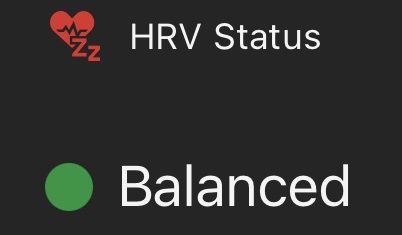
My Garmin HRV status finally returned to “Balanced”—more than six weeks after the Georgina Marathon.

My resting heart rate remains somewhat higher than my previous baseline, but it has been gradually improving.
Meanwhile, my Garmin-predicted VO₂ max appears to have finally bottomed out and is beginning to climb again.


For the first time since Georgina, Garmin is also classifying my training status as “Productive.”

Of course, these metrics are only estimates and don’t tell the whole story. Nevertheless, it’s reassuring to see them gradually moving in the same direction as my subjective sense of recovery.
Looking back, the contrast between my recovery from the BMO Vancouver Marathon in May and the Georgina Marathon in September is quite striking.
After BMO, I developed injuries that significantly disrupted my training. It took weeks before I could return to consistent running, and the loss of fitness felt incredibly discouraging.
This time around, despite the initial fatigue and declining fitness metrics, I managed to avoid another significant injury.
My recovery has been much smoother, and I’ve been able to rebuild my training volume gradually.
Perhaps the biggest difference, however, has been my mindset.
Having already experienced a much deeper setback after BMO, I was far less anxious this time when I watched my fitness metrics decline.
I knew that recovery would take time.
I also knew that the fitness I had worked so hard to develop hadn’t simply disappeared overnight.
I’ve become much more patient and confident in the process of rebuilding.
Sometimes experience doesn’t necessarily make the physical recovery faster, but it certainly makes the psychological recovery easier.
My Wife’s Training: Knowing When to Take an Extra Rest Day
My wife also continued making steady progress toward her first marathon in Tokyo.
This week, she completed:
| Training | Completed |
|---|---|
| Easy runs | 3 × 40 minutes |
| Long run | Postponed |
| Running-specific strength training | 2 sessions |
We had originally planned a 70-minute long run together on Sunday.
However, after spending several hours walking with the children during Halloween trick-or-treating the previous evening, her legs were feeling unusually fatigued.
Rather than forcing the scheduled long run, we decided it would be wiser to take some additional recovery time and postpone the session until Tuesday.
This is an important lesson, particularly for someone training for their first marathon.
A training plan is a guide, not a commandment.
It’s easy to become overly focused on completing every scheduled workout exactly as written.
But our bodies don’t distinguish between stress from running and stress from other physical activities in our daily lives.
Prolonged walking, standing, poor sleep, work demands, and other sources of fatigue can all influence how well we recover and how much training we can tolerate.
Sometimes, the smartest training decision is to modify the schedule.
Missing or postponing one long run will have virtually no meaningful impact on her marathon preparation.
On the other hand, forcing a long run when her legs are already excessively fatigued could increase the risk of an injury that might disrupt several weeks of training.
That’s simply not a worthwhile trade-off.
I want her to learn to recognize the difference between ordinary reluctance to train and genuine physical fatigue that warrants additional recovery.
Consistency matters, but consistency over months is far more important than completing every individual workout.
So far, she’s progressing well, and I’m pleased with how she’s adapting to the increasing training demands.
Looking Ahead: The Quiet Months of Base Building
With the Great Trek behind us, there are no major races on my immediate calendar.
For the next couple of months, my training will probably look remarkably similar from week to week.
Lots of easy running.
Short hill sprints and strides.
Gradually increasing mileage.
Running-specific strength training.
And, hopefully, plenty of uneventful, injury-free weeks.
There probably won’t be many exciting race stories or dramatic training breakthroughs to share during this period.
But that’s perfectly fine.
In fact, boring training is often exactly what successful endurance training looks like.
The real progress happens through the accumulation of hundreds of ordinary workouts, completed consistently over many months.
For that reason, I’ll probably transition to providing updates approximately every four weeks, unless something particularly interesting happens along the way.
This will allow me to focus on the training itself while still documenting the more meaningful milestones and lessons.
The Journey Continues
Twenty-two weeks into the Road to Boston, I’m finally beginning to feel that my body is emerging from the prolonged recovery period following Georgina.
My training volume is becoming more consistent, my recovery metrics are improving, and I’ve started carefully reintroducing some faster running.
Meanwhile, my wife continues making steady progress toward Tokyo, learning not only how to run farther but also how to balance training with recovery and everyday life.
There’s still a long road ahead.
But for now, I’m happy to keep things simple.
No heroic workouts. No unnecessary risks. Just consistent training, week after week.
The Road to Boston—and the Road to Tokyo—continues.
See you next time!
Leave a Reply