Road to Boston – Week 20.
The journey continues from last week.
Time certainly flies when you’re training for a big race. It’s hard to believe that my wife and I are already four weeks into our training block for the Tokyo Marathon in March 2027.
This week was relatively uneventful in terms of training, although there were a few unexpected reminders of why injury prevention and patience are so important.
My Training: A Deload Week
This week, I ran five days for a total of 59 km, all at an easy pace.

After three consecutive weeks of gradually increasing my running volume, I decided to make this a bit of a deload week to allow my body some additional time to recover and adapt.
My legs still haven’t completely returned to normal since the Georgina Marathon, so I haven’t reintroduced any structured speed work yet. I’m certainly looking forward to running fast again, but I know there’s no benefit in rushing the process.
Hopefully, I’ll be ready to start incorporating some faster sessions soon.
A Close Call with a Screw
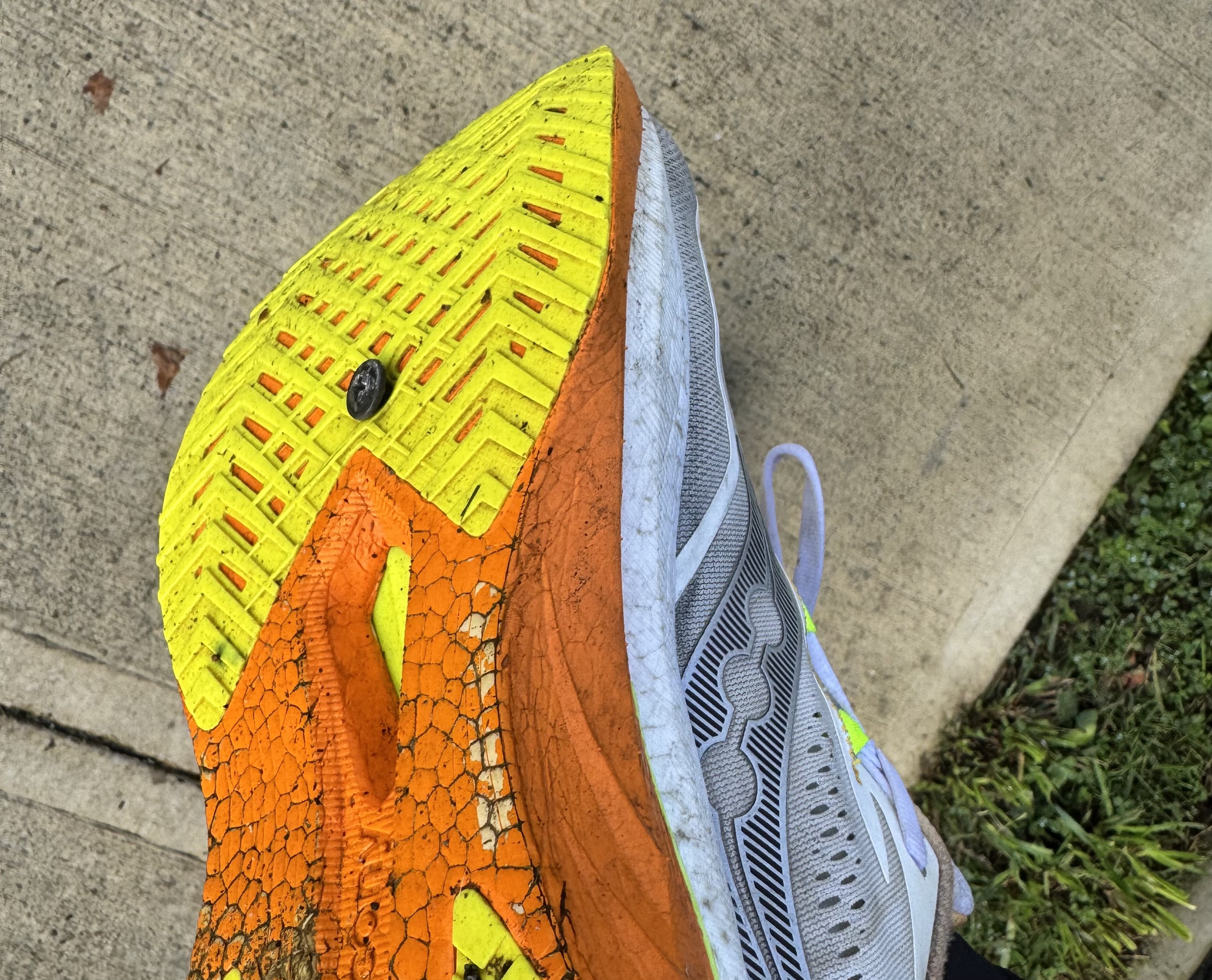
During one of my easy runs this week, I suddenly felt an unusual pressure underneath my right foot.
Initially, I thought I had picked up a small rock that had become lodged in the sole of my shoe.
When I stopped to inspect it, however, I discovered something much more concerning.
A screw had gone straight into the bottom of my running shoe!

Thankfully, the screw wasn’t long enough to penetrate all the way through the sole, and my foot was completely unharmed.
That was a close call.
I couldn’t help thinking about how badly things could have gone if the screw had been just a little longer.

After spending so much time trying to recover from injuries and rebuild my fitness, the last thing I need is another setback caused by something completely unexpected.
Sometimes, you can do everything right with your training and still encounter risks that are entirely outside your control.
I’m just grateful that this one ended without an injury.
A Reminder That Time on Your Feet Matters
Another interesting experience this week came from attending a concert.
I spent more than three hours standing throughout the show.

Normally, that wouldn’t seem particularly demanding. However, I had already run 16 km the previous day and another 10 km earlier on the day of the concert.
By the end of the evening, my feet were definitely not feeling great.
It reminded me of something that’s easy to overlook when monitoring training load:
Running isn’t the only activity that places stress on your feet.
Standing still for prolonged periods is also weight-bearing, and it adds to the cumulative load on the plantar fascia and other structures supporting the feet.
Given the early warning signs of plantar fasciitis I experienced last week, I decided to take an additional rest day to allow things to settle down.
I’m certainly not interested in repeating the plantar fasciitis episode I experienced around this time last year.
One of the biggest lessons I’m learning during this base-building phase is that training volume needs to increase naturally, rather than being forced.
There’s no point in pushing for a particular weekly mileage if my body isn’t ready to tolerate it.
The goal is to build a sustainable foundation that will support many months of consistent training.
Recovery and Health Metrics
My recovery continues to progress, although more slowly than I initially expected.
My HRV has been gradually improving but still hasn’t returned to its previous baseline. My resting heart rate also remains somewhat elevated compared with my usual values.

Subjectively, I can still feel some lingering fatigue from the Georgina Marathon.
It’s surprising how long the effects of a marathon can persist, even after the obvious muscle soreness has disappeared.
Meanwhile, my Garmin-predicted VO₂ max has continued to decline, although it finally seems to be stabilizing.


As I’ve mentioned previously, I’m not particularly concerned about that number at this stage.
Most of my training has been deliberately slow, and I’m prioritizing recovery and aerobic base development over speed.
What matters more to me right now is how my body feels, whether I can run consistently without discomfort, and whether my overall recovery continues to improve.
Full recovery is taking longer than expected, but patience remains the priority.
My Wife’s Training: Discipline Over Motivation
My wife had another successful week of training.
She completed all her scheduled sessions:
| Session | Duration |
|---|---|
| Easy Run 1 | 35 minutes |
| Easy Run 2 | 35 minutes |
| Easy Run 3 | 35 minutes |
| Long Run | 65 minutes |
| Strength Training | 2 sessions |
One thing I’ve noticed is that her motivation isn’t always particularly high before starting a workout.
Sometimes, she simply doesn’t feel like going for a run or starting a strength session.
But once she finishes, she’s always glad that she did it.
I frequently remind her that marathon training isn’t always glamorous.
In fact, much of it can feel like a grind.
There are days when you’re tired, busy, or simply not in the mood to train. The initial excitement of signing up for a marathon gradually wears off, and the reality of following a training schedule week after week begins to set in.
This is precisely why I believe relying solely on motivation is a recipe for inconsistency.
Motivation comes and goes.
What matters is what you choose to do when motivation isn’t there.

Of course, there’s an important distinction between pushing through a lack of motivation and ignoring genuine signs of illness, injury, or inadequate recovery. The former builds consistency; the latter can derail it.
But when the body is ready and the only obstacle is not feeling particularly enthusiastic, following through with the planned session is an important part of developing discipline.
In many ways, I believe this is one of the fundamental lessons of marathon training—and marathon racing itself.
Over the past four weeks, my wife’s running pace has steadily improved, and her endurance has noticeably increased.
Most importantly, she hasn’t experienced any warning signs of injury.
Overall, she’s making excellent progress.
Running in the Rain: A New Challenge
This week also brought another milestone for my wife and children.
Their first rainy runs of the year!
They’ve been incredibly fortunate with the weather and somehow managed to avoid running in the rain throughout the entire year so far.
Of course, living in Metro Vancouver, that streak was never going to last forever.
With autumn arriving and the weather becoming cooler and wetter, I was curious to see whether the rain would discourage them from completing their scheduled runs.
Thankfully, it didn’t.

They went out as planned and actually enjoyed the refreshing experience.
I’m glad they had a positive introduction to running in the rain.
Now we’ll see whether that enthusiasm survives the colder, darker, and much wetter months ahead!
After all, marathon training doesn’t stop just because the weather isn’t ideal.
Looking Ahead: UBC Great Trek Half Marathon and 5 km
Next weekend is the UBC Great Trek, and it’s shaping up to be an exciting family running event.
I’ll be participating in the half marathon, but rather than racing it, I’m planning to complete the distance at an easy pace as part of my aerobic base training.
Afterward, I’ll be pacing my almost 12-year-old daughter as she attempts to set a new 5 km personal best.
Her current PB is 29:30, and she’s been training consistently over the past several months.
We’ve incorporated some speed work into her training this week to sharpen things up before the race.

I’m excited to see what she can do.
My wife will also be participating in the Great Trek 5 km, treating it as one of her scheduled easy runs for the week.
Between the half marathon and pacing my daughter, I’ll be covering more than 26 km that morning.
That will make it my longest running day since the Georgina Marathon.
Given that I’m still recovering and have been experiencing some intermittent foot discomfort, I’m planning a small taper in the days leading up to the event to reduce fatigue and minimize injury risk.
I’ll also be paying close attention to how my feet feel. If the discomfort returns, I’ll need to adjust my plans rather than force the distance.
The last thing I want is to turn a fun family race weekend into another injury setback.
The Journey Continues
Four weeks into the Road to Tokyo and twenty weeks into the Road to Boston, the training continues.
My wife is becoming a stronger and more confident runner. My children are learning to embrace running even when the weather isn’t perfect. And I’m continuing to rebuild my fitness while learning to respect the recovery process.
If there’s one recurring theme over the past few weeks, it’s this:
Consistency is important, but consistency also requires knowing when to rest.
I’m looking forward to next weekend’s Great Trek event and, hopefully, celebrating some new family running milestones.
See you next week!

Leave a Reply