The Road to Boston continues after the Georgina Marathon.
This week has been quite rough, both physically and psychologically.
The Body Isn’t Ready Yet
Physically, I haven’t felt particularly good since the marathon—which, of course, isn’t unexpected after running 42.2 km.
My left calf and right quadriceps continue to be sore from the race, although both are gradually improving day by day. I can now walk fairly normally without discomfort, which is encouraging.


Yesterday, I decided to test things with a very easy recovery jog.
I made it about 10 steps.
Almost immediately, the discomfort returned, so I stopped the run right away. It was a pretty clear message from my body:
I’m not ready to run yet.
So, for now, running will have to wait.
The Mental Recovery Has Been Harder
More challenging than the physical fatigue has been the mental fatigue.
My entire system still feels exhausted after the marathon. Even though I didn’t race at 100% effort, 42.2 km is still an enormous physical stress, especially after 15 weeks of structured training.
I’ve been feeling mentally drained throughout the day, even when I’ve had plenty of sleep. I have very little interest in doing much of anything. I’m more irritable than usual and have much less patience. I have absolutely no desire to cross-train, strength train, or even go for a walk.
Sleep quality has also been poor, with lots of tossing and turning. My mind feels scattered, and I’ve had difficulty concentrating.
Taken in isolation, some of these symptoms can resemble those seen in depression. In my case, however, their abrupt appearance immediately following the marathon and prolonged training block makes post-race physical and psychological fatigue an important part of the picture.
People sometimes refer to this experience as the “post-marathon blues.”
I experienced something similar after the BMO Vancouver Marathon a few months ago, and it took several weeks before I began feeling like myself again.
This is one reason runners often take meaningful downtime after a marathon. Recovery isn’t just about repairing sore muscles. There is also a psychological component to recovering from months of structured training followed by the enormous build-up and stress of race day.
But taking time off is easier said than done.
When you’re accustomed to training almost every day, suddenly doing nothing creates its own set of doubts:
Am I losing fitness?
Is something wrong with me?
Am I being lazy?

I keep reminding myself that recovery is part of the training process. Right now, the best thing I can do for my future fitness may actually be to stop chasing it.
Trust the process and be patient.
That’s much easier to write than it is to actually do.
My Appetite Has Gone Through the Roof
Another interesting change this week has been my appetite.
I’ve been hungry all day long, with particularly strong cravings for fatty, salty, and sugary foods.
I’ve done a reasonable job controlling those urges, but I’ve also realized that perhaps I shouldn’t be fighting them quite so aggressively. My body has just gone through a marathon and is trying to repair itself. Increased hunger may simply be one signal that it needs more energy and nutrients.
For that reason, I’ve deliberately allowed myself to eat more this week—approximately 1,000 calories above my usual maintenance intake each day.
Most of those additional calories have come from nutrient-dense whole foods, particularly more fruit, peanuts, and tree nuts.
Some fat gain may come with the additional calories and temporary pause in training, and I’m okay with that. Right now, recovery and long-term health are more important than staying as lean as possible.
I’m still sticking predominantly to whole foods, but I’m also not going to feel guilty about the occasional slice of mooncake or some chocolate when the craving hits.
There is a time to be disciplined about body composition.
The week after a marathon probably isn’t the time to obsess over it.
Why I Don’t Want to Race Marathons Too Frequently
This week has also reinforced something I’ve been thinking about for a while:
I don’t want to race too many marathons each year.
The marathon itself is only one day, but preparing for and recovering from it can consume much more time. There is the taper beforehand, followed by the physical and psychological recovery afterward.
For me, the sensation after a marathon isn’t simply tiredness.
The best description I can think of is a “deep malaise.”
It feels fundamentally different from recovering from a normal hard workout—or even from shorter races.
All of this takes time away from consistent training, which is ultimately where long-term fitness is built.
Going forward, I’m planning on racing approximately two marathons per year. I may participate in additional marathons recreationally, but only if I can run them at a controlled effort without significantly disrupting the larger training plan.
Still Fighting the Cold
Unfortunately, the cold I picked up before Georgina continued to evolve throughout this week, although I think I’m finally past the worst of it.
I’ve also developed a significant cold sore on my lower lip, another sign that my body has been under considerable stress.
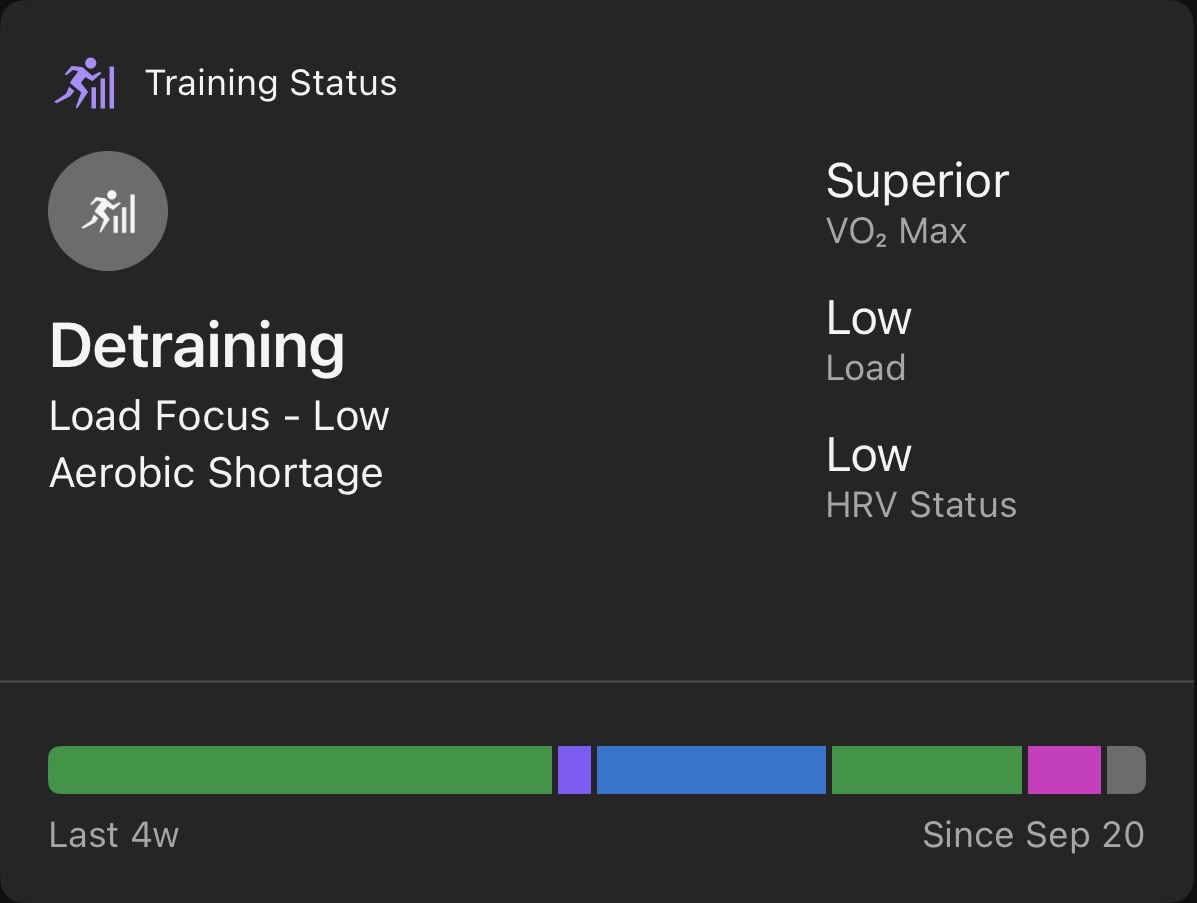
My HRV has continued to fall, while my resting heart rate remains higher than normal. Those are useful additional pieces of information I’ll be watching alongside how I actually feel as I decide when I’m ready to resume structured training.

For now, the answer remains:
Not yet.
And that’s okay.
A New Journey Begins Next Week
There is, however, something I’m really looking forward to.
Starting next week, my wife begins her 24-week training block for the Tokyo Marathon.
This will be her first marathon.
Her longest race so far has been 10 km, so 42.2 km will be a completely new challenge. But with 24 weeks available, we have plenty of time to gradually build her running volume, develop her endurance, practise fueling, and prepare her for the distance.
This time, I’ll get to experience marathon training from a very different perspective.
I’ll be her coach.
Over the past year and a half, I’ve learned an enormous amount through my own training—the successes, the injuries, the mistakes, the experiments, and the races that didn’t go according to plan.
Now I get to put some of those lessons to use helping someone else prepare for her first marathon.
Hopefully, I’ll recover enough to start joining her on some of those runs soon.
For now, though, she’s beginning her build while I’m doing something that doesn’t come nearly as naturally to me:
Resting.
The Road to Boston continues—but this week, moving forward means standing still for a little while.
See you next week.


Leave a Reply