The journey continues from last week.
This week, both training volume and intensity increased significantly as I entered the heart of my peak training phase. The week consisted of 5 runs, 6 cycling sessions, and 2 running-specific strength sessions.

Total running volume climbed to over 82 km, while my cycling sessions increased to 55 minutes per day, bringing my weekly cycling volume to approximately 200 km.


Fatigue is definitely accumulating, which is expected during these peak weeks. Thankfully, I remain injury-free and seem to be recovering reasonably well.
To prioritize my Wednesday speed session and Sunday long run, I’ve deliberately slowed down my easy and recovery runs. By making my training more polarized—keeping the easy days truly easy—I can recover better as the overall volume increases while still getting the intended training stimulus from my key workouts.
My strength training also continues to progress. I’ve gradually increased the weights and resistance over time, and I’m continuously feeling the benefits during my runs. My legs simply feel stronger and more resilient than they did during my previous marathon training block.

Wednesday Speed Session
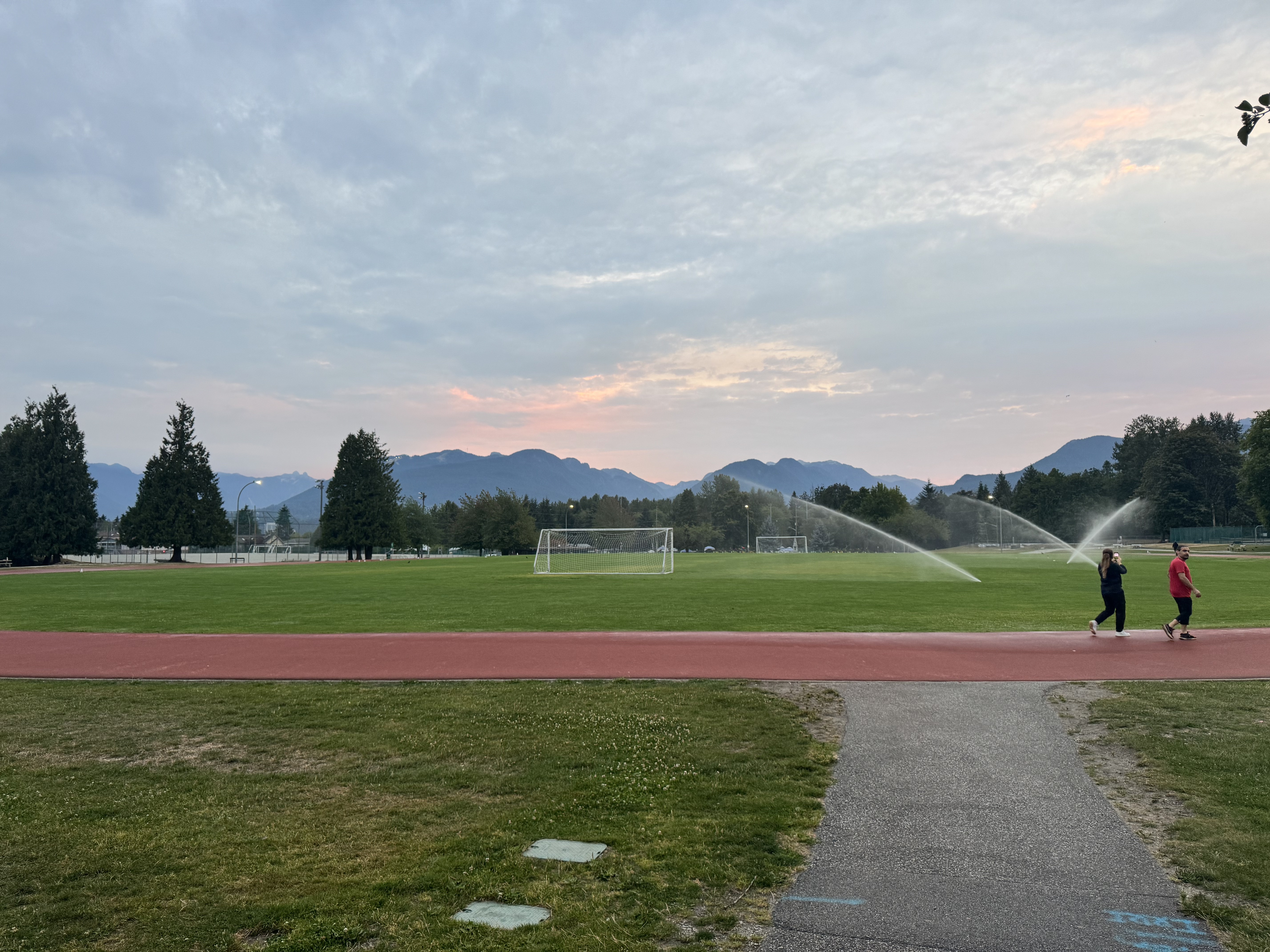
Wednesday’s speed session took place once again at the Burnaby Confederation Park track.

The workout consisted of:
- 2 × 10 minutes in Zone 3, with 90 seconds of walking recovery
- 2 × 5 km in Zone 4, with 60 seconds of walking recovery
- 8 × 75 seconds in Zone 4, with 30 seconds of walking recovery

Overall, it was a solid session that I felt was well executed. With the training volume continuing to increase, I’m becoming increasingly conscious of hitting the intended effort rather than trying to outperform every workout.

The goal isn’t to win Wednesday’s training session.
The goal is to be ready on race day.
Sunday: The 38 km Dress Rehearsal
Sunday’s long run returned once again to my familiar training ground at Burnaby Confederation Park.

This was a big one: 38 km total.

The main portion of the workout consisted of a 30 km segment alternating between 4 km in Zone 3 and 1 km in Zone 2.

I did misread my coach’s instructions slightly, but fortunately, the session I completed was close enough to provide the intended training stimulus.
More importantly, I used this long run as an opportunity for a full race-day dress rehearsal.
I increased my carbohydrate intake the day before, wore my planned race-day apparel, and carried my nutrition and hydration exactly as I intend to on race day. At this stage of marathon preparation, I’m not only training my cardiovascular system and legs—I’m practicing the entire race-day process.
Overall, the session went well.
Toward the end, however, I could definitely feel the accumulated fatigue in my legs and began approaching the dreaded “wall.” I had to dig deep to complete the final portion while simultaneously reminding myself not to push so hard that I turned a productive training session into an injury.
That’s a surprisingly difficult balance.
I intentionally did not carbohydrate-load to the same extent that I plan to before the actual marathon. I’m hoping that with a more aggressive and optimized three-day carbohydrate-loading strategy before race day, I’ll be able to delay the onset of that late-race fatigue.

During this run, I successfully tolerated approximately 90 g of carbohydrates and 750 mg of sodium per hour without significant gastrointestinal issues. In my upcoming long runs, I plan to experiment with gradually increasing carbohydrate intake toward 120 g per hour and see how well my stomach tolerates it.
Near the end of the session, my family joined me at the track to cheer me on and complete their own 35-minute run.

Having them there for those final kilometres gave me a much-needed boost.
Health Update: A Big Sigh of Relief
I also received some very reassuring news this week.
My brain MRI came back normal, with no tumour or other structural abnormalities identified.
That was a big sigh of relief.
I haven’t yet received the final results from my EEG, although I’m hopeful that it will also be reassuring. At this point, the working explanation for the neurological symptoms I experienced during several hot long runs remains migraine with aura without headache.
For now, my focus is on identifying and minimizing potential triggers, particularly overheating, dehydration, electrolyte imbalance, and bright sunlight.
Most importantly, I haven’t experienced another episode.
Nutrition
My overall nutrition strategy remains largely unchanged.
On Wednesdays and Sundays, I deliberately increase carbohydrate intake before, during, and after my key workouts to support performance and recovery.
On the remaining days, my diet focuses primarily on lean protein—usually chicken breast—along with large amounts of fruit, vegetables, and Greek yogurt.
Simple, repetitive, and perhaps not particularly exciting. But it works for me.
Fitness Update
My fitness metrics continue to move in the right direction.
My Garmin-predicted VO₂ max has now reached 56, putting me very close to my previous peak of 57 before the BMO Vancouver Marathon.


My running pace at each training zone is also steadily improving.
| Metric | Current |
|---|---|
| Garmin Predicted VO₂ Max | 56 |
| Zone 1 Pace | 5:30–6:00/km |
| Zone 2 Pace | 4:40–5:30/km |
| Mid-Zone 3 | 4:15–4:20/km |
| High-Zone 3 | 4:00–4:15/km |
| Zone 4 | 3:45–4:00/km |
| Weight | 64.7 kg |
My HRV remains stable and within its balanced range, while my resting heart rate continues its gradual downward trend. On one night this week, it even reached 40 bpm.


The 64.7 kg weigh-in also came after a day of increased carbohydrate intake, so some of that number likely reflects additional glycogen and associated water storage.
Overall, the numbers suggest that my fitness is getting very close to where it was before the Vancouver Marathon.
Now comes the harder part: becoming fitter than I was before.
Four Weeks to Georgina
There are now only four weeks remaining until the Georgina Marathon and my Boston qualifying attempt.
And I’ll admit it: I’m not entirely confident that I can do it.
Running 42.2 km at approximately 4:07/km still feels like a stretch based on where my fitness currently stands.
The next couple of weeks of training, recovery, adaptation, and eventual taper will therefore be crucial. I’ll also be discussing race strategy with my coach to determine what a realistic target should be based on my fitness as race day approaches.
The goal remains the same.
Sub-2:54.
Whether my body will be ready to deliver it remains to be seen.
Fingers crossed.
And After Georgina… Tokyo!
There was also some very exciting news this week.
My wife and I have secured spots in the Tokyo Marathon on March 7, 2027!

This will be our first World Marathon Major, and I’m incredibly excited that we’ll get to experience it together.
Once Georgina is behind me, another training journey will begin—this time with both of us preparing for Tokyo and all the challenges, setbacks, and adventures that will undoubtedly come with it.
But first, there is still unfinished business.
Four weeks to Georgina.
Leave a Reply