
Lately, my children (aged 11, 9, and 5 at the time of this post) have caught my running bug and want to get started as well. So I have decided to write this blog post as a guide to help them succeed. I will write this in a way that my children can understand the concepts, so hopefully it is also intuitive for you.

Before you get started with running, I suggest you go through my Weight Loss Mini-series first, and get into the habit of walking, as discussed in Part 3.0. Running at a higher body weight places significantly more stress on the joints, making the process more difficult, less enjoyable, and harder to sustain long term.
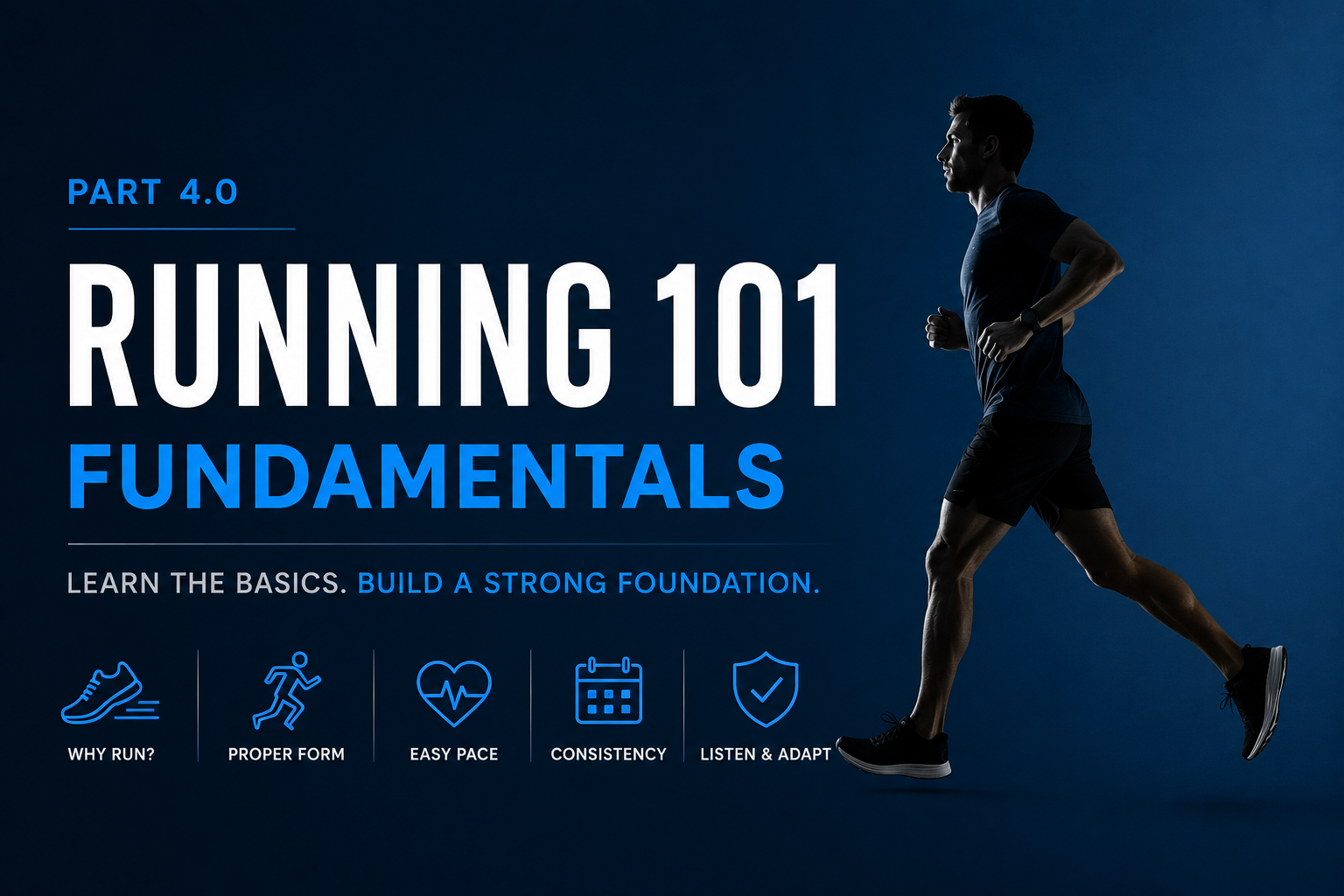
In Part 4, I will begin a mini-series on running—my experiences with it, and how I would approach it as a beginner. Part 4.0 will serve as a primer on the fundamentals of running to get you started on the right footing. Then we will cover the following topics in subsequent posts:
Part 4.1: The Science of 80/20 Running
Part 4.2: Running Shoes and Gadgets
Part 4.3: Running Data Collection
Part 4.4: Running Injuries, Recovery and Prevention
Part 4.5: Strength Training for Runners
Part 4.6: Running Specific Drills
Part 4.7: Running Specific Nutrition
Part 4.8: Rest, Recovery and Repair
Part 4.9: Signing up for Your First Race
Part 4.10: Gamification of Running
First, answer these questions either out loud or in your head:
- When you hear the word “running,” what is the first emotion that comes to mind?
- What is your personal experience or relationship with running, and how does it make you feel when you run?
- If a genie gave you one running-related wish, what would it be?
For me, the answers to these questions have changed over the course of my first year of my running journey:
- Before: Torture → After: Fun
- Before: I always hated running and felt out of breath quickly → After: I look forward to my next run and feel great during it
- Before: I wish running felt effortless → After: I wish I could run alongside elite runners of the world
Most people have a difficult relationship with running. Many of us ran only because we had to—catching a bus, rushing to class, or being forced to run in PE class. I was the same. I used to feel sick after 400–800 meters in school PE. I dreaded it and associated running with suffering, fatigue, and nausea. It drained energy instead of adding to my life. It wasn’t until I started running as a mid-aged adult that I realized most of us, myself included, had been approaching it the wrong way.
In this post, I will go through the basics of running and how to get started the right way.
To succeed in running and make it an enjoyable experience, you need to focus on three main ideas:
- Long-term mindset and goal setting
- Building the engine
- Making it feel too easy
Let’s expand on each of these.

Long-term mindset and goal setting
Your ability to run improves over time. While you can make noticeable gains in the early phases of training, long-term improvement requires patience and consistency.
It is helpful to sign up for a race to create a deadline and hold yourself accountable. This could be a 5 km, 10 km, or any personal goal with a set timeline. A goal gives direction and meaning to each running session.
Over the long term, the goal is for running to become a habit that feels unshakable—just like how it feels strange to skip brushing your teeth, it should feel strange not to run regularly. If you can achieve this, then half the battle is already won.
Once again, we often overestimate what we can achieve in the short term and underestimate what we can achieve in the long term. Personally, over the course of about a year, I went from struggling to run 3 km continuously to completing my first full marathon (42.2 km), and I am now aiming for a sub-3-hour marathon in the coming months. Day by day, and even week by week, it was often difficult to notice meaningful changes in fitness. But when you trust the process and stay consistent, the long-term adaptations can be surprisingly significant.
Building the engine
Your running engine is your heart.
For most beginners, especially those coming from a sedentary background, the main limiting factor is cardiovascular fitness. The body adapts to the demands placed on it, so if your heart is not regularly challenged, it will not be trained to perform under effort.
In the beginning, many people find it difficult to run at any pace. As soon as they start running, their breathing becomes laboured, and the experience quickly feels uncomfortable and unsustainable.
The good news is that the heart adapts relatively quickly—usually over weeks to months. In the early phase, your focus should be on cardiovascular adaptation. This is what ultimately allows you to run faster and longer later on.
Make it feel too easy
Walking feels easy, and often enjoyable, especially in places like parks or along the beach. The goal is to make running feel the same way—easy and enjoyable.
All of your runs should feel easy—almost too easy. It may feel slow, unproductive, or even slightly embarrassing at first, but you need to trust the process.
Focus on your breathing, your surroundings, and your body.
You should be able to hold a full conversation during the effort. If you cannot, you are going too fast.
In many cases, this will mean walk–jog intervals rather than continuous running:
- walk most of the time
- jog briefly
- repeat
There is no ego in easy running. In fact, ego is one of the biggest barriers. The goal is not to go fast—the goal is to build a foundation so that fast running becomes possible later.
If you are unsure whether you are going too hard, you probably are.
A simple rule: you should be able to breathe through your nose during easy runs.
Here is a helpful video by Floris Gierman on easy running / Zone 2 training:
https://www.youtube.com/watch?v=taO8kKsx448
How I would progress your initial running
Start with walking, as discussed in Part 3.4, until you can complete at least 5 walks per week:
- 1 longer walk (~65 minutes)
- 4 shorter walks (~35 minutes)
These walks should feel fully recoverable each week. If fatigue accumulates, do not progress yet.
In the beginning, focus on time on feet rather than distance. If you have a GPS watch, you can still track distance, but it is not the primary metric.
Over time, you will naturally notice that distance increases at the same effort—but this should not be forced.
Once walking feels comfortable, begin introducing light jogging intervals after a proper walking warm-up:
- 15 seconds jogging
- 60 seconds walking
- Repeat
Keep the total session durations the same as before (65, 35, 35, 35, 35 minutes per week). Finish every session with a walking cooldown to allow your heart rate and breathing to gradually return to baseline.
Always keep it easy. If you are unsure whether you are doing too much, slow down, reduce running time, or increase walking time.
Over weeks, gradually increase running duration and reduce walking duration. Stay patient and consistent.
Eventually, a breakthrough will happen: you will be able to run continuously for the entire session at a conversational pace. This is a milestone you will remember.
At that point, you can gradually progress toward:
- 90 min
- 65 min
- 65 min
- 65 min
- 65 min sessions
Only progress when your body is ready. This may take months.
Once you can consistently run without injury at this weekly volume, you can begin adding speed work (introduced in Part 4.1).
There you have it. If you follow these steps, you will build a strong foundation for your running journey.
In Part 4.1, I will talk about the science of running and introduce the concept of 80/20 training.
Leave a Reply